Wednesday, February 26, 2014

Saving the City of Ember

      I'm am so excited to finally get to this summative assessment for our unit of inquiry into energy- specifically how innovations of today will affect our lives in the future.
   
     Yesterday we thought back to the story of Ember and came up with a list of problems they had in the city, there were many.  We had to narrow the list down to what we thought we could engineer in the classroom, with limited materials as could be found in the city of Ember.  We arrived to three problems:
* Lack of a mail system- they rely on messengers to run the messages around town
* the yarn in Granny's shop was out of control
* They didn't have a good way to organize or access materials in the storage rooms.
    The children voted on their top choice of what problem they would like to solve. I then looked then broke them into groups based on their choices.

     Today we were able to get into our groups and begin to brainstorm a device we could build to solve the problem.  The students will be scored on a rubric as shown below so they frequently referenced that as they worked through the design process.  Tomorrow I will give them a preview of some of the items that will be available to "purchase" to create their design.  This will allow them/force them to go back and make revisions to their plans over the next few days.


Tuesday, February 18, 2014

When Science Fails

Wawawa.... You know those great inquiries that you have all planned out and oh what fun it will be, the kids will be so engaged and I can't wait to hear their thinking... Yeah reality sets in and the experiment FLOPS.  It was one of those days yesterday.  We were conducting an investigation into what happens to the energy when two objects collide.  (PS3.C)  So we set out to see what happens when two mables, attached at then of a string (like a double pendulum) collide.  Sounds doable right?!


Yeah, you know what happened....NOTHING! They just flew past each other or the strings got tangled and just wound around each other.  So, we weren't able to measure the effect of the collision, or really observe the energy transfer.  Great- another fabulous (in my head) idea out the window.  

I had to go back to the drawing board and think about how I can get the students to understand this concept, because obviously the marble idea was not a success.  Well, why not bring in another standard that requires them to design and test a model?  So that is just what I did on day two.  We began by talking about what scientists and engineers do and how often times it will take several attempts to successfully find solutions to problems.  That is just what we had to do now.  I gave them the task of designing their own model that would demonstrate what happens to energy when two objects collide.  They had to design their model within the following parameters: 
    - It had to be something that could be easily replicated.
    - The materials used had to be those that I could get access to easily at school or at home. (no crashing of cars into walls etc).  

Their designs were great!! I was so excited to see them applying all aspects of science AND bringing in what we've been investigating in language workshop!! 


 Whew, much more successful and way more meaningful for them!! I had so many of them go home that night and try out their models- it was awesome!! 

Monday, February 10, 2014

Another Science Mystery

     Have I mentioned my love for science....?? NO?!  Well let me know tell you this girl loves science, I love everything about science and how it can get your most reluctant readers and learners engaged.  Science is the area that helps students see the link between the skills they are learning in reading and math and what we do as everyday scientists.
     The new NGSS has added in the the engineering component which I believe is crucial to problem solving, and developing a true appreciation for science.  Through the lens of an engineer/scientist we began our inquiry in to sound waves.  We read another mystery from a great text called Everyday Science Mysteries.
Definitely worth a read through!
     Today the kids were given a problem where two girls are trying to communicate with a TCTS device (tin cans connected by string).  The students are then posed with the problem of how to make their communication more clear.  After reading the story the students got out their content journals and wrote their hypothesis to test to see how they could help the girls engineer a new TCTS device.


     The students then went out, gathered their materials and tested their new designs.  It  was great to see what they came up with!  They may not have seen themselves as engineers, but that is exactly what they were doing- planning, testing, and redesigning their ideas.  AMAZING!


   The conversation that followed their work was awesome.  They had some great ideas of why their design did or did not work.  Many were going to take some action at home and test out some different design theories that they had, with supplies I was unable to provide. The students debated if it was the type of string used that may have inhibited the sound. They speculated that since the fibers were looser on yarn than the string that the waves would have a harder time traveling through.  Really?! Wow that is some great thinking and hypothesizing!!! 


Thursday, January 30, 2014

Get to the POINT!

   As we move through our genre of informational text (procedural) I want my children to truly understand how to develop a topic for an audience.  One thing they must do is to think of not only the topic, but also what is the point they are trying to make with their readers.  In an informational text the point or focus of the topic is stated in the conclusion, throughout the body, and in the conclusion.  In order to do this the children must ask themselves questions about what they've read and what they're writing.


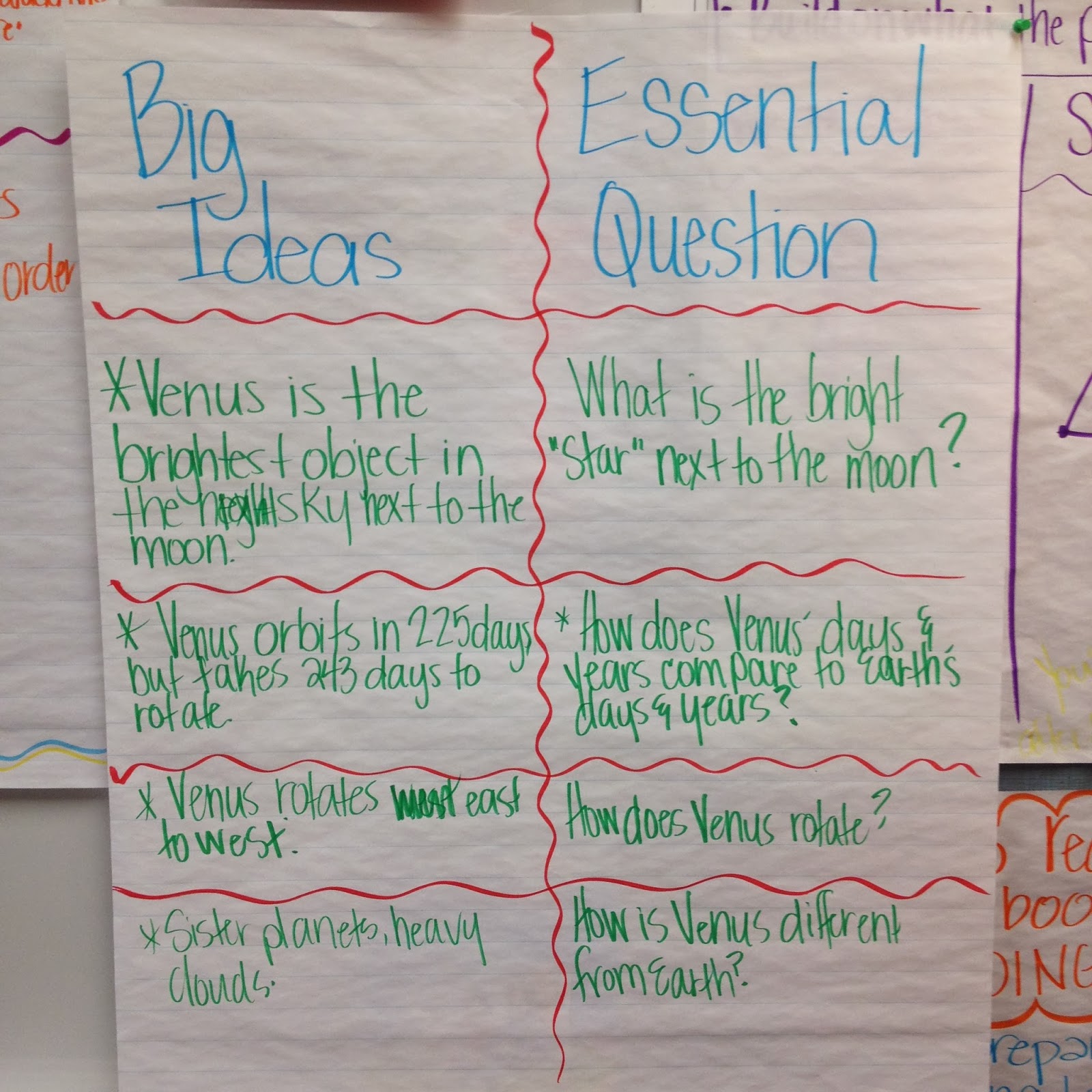
Using the book Nonfiction Mentor Text as my guide I set out to do just this.  After looking at these questions we then used Venus by Seymour Simon book (used earlier to teach text structure) to determine what were his big ideas and what essential questions did he use that guided his writing.  I reminded students again and again throughout the process that we write with the reader in mind! Here is their thinking after reading the first few pages of the book: 


I'll be honest- it was really hard for them to come up with question that he sought to answer.  Definitely a skill that we will be developing as we move through this genre!  


Day 2 of Close Reading

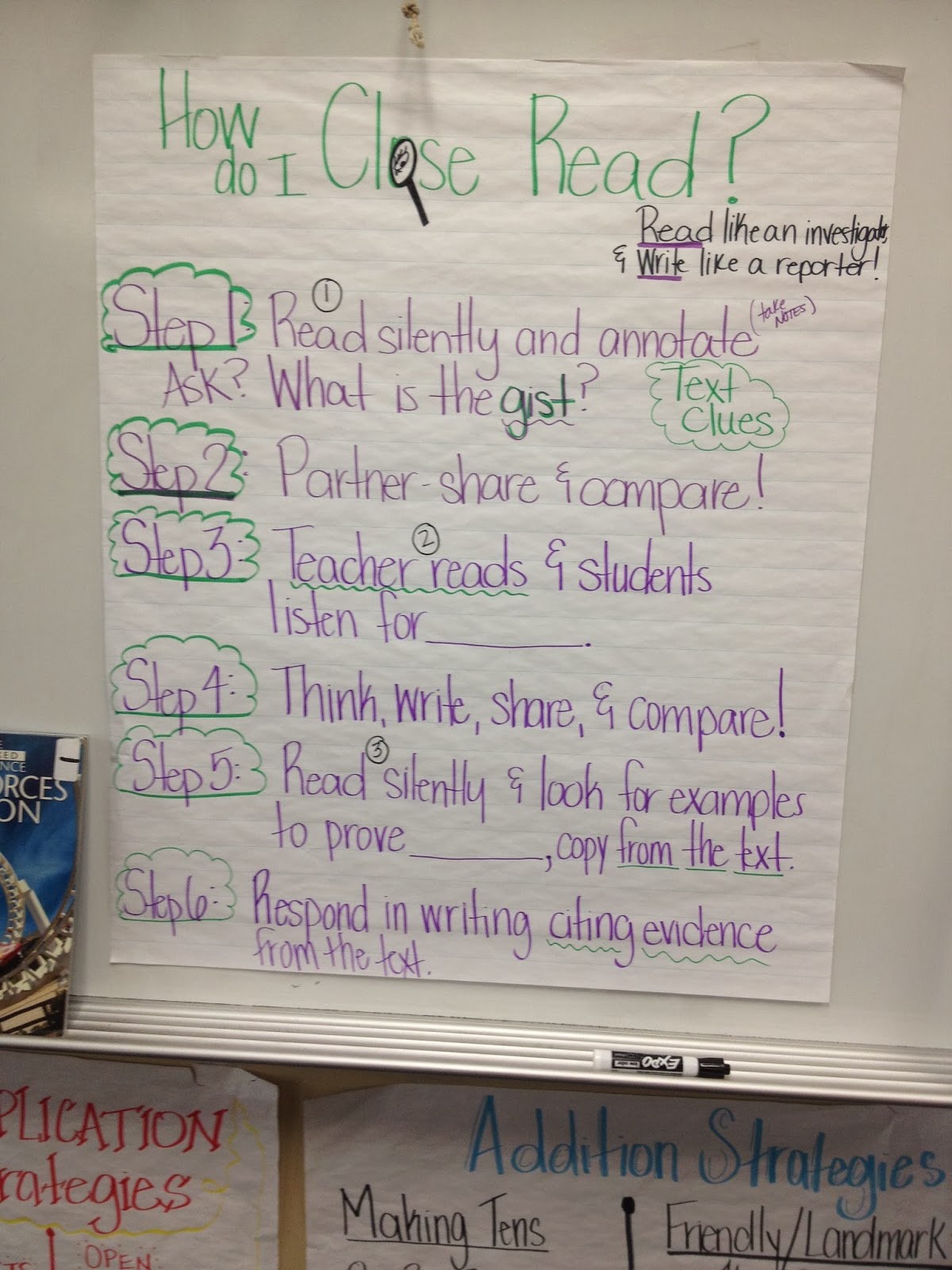
On this day we went back to our article from Newsela and explored the next few steps in close reading.  After reviewing what they wrote yesterday during their reflection of the article, they once again read the article, but this time with a specific focus.  I wanted them to read the article and find evidence that proves that this is an important piece of technology.  The goal of close reading is to really get kids to read and understand what is happening in the text.  Read like investigators and write like reporters!  This is a valuable skill to learn as we will be moving forward with research, it will help them read with a question in mind and find information that meets their purpose.  

I can't find the original source for the anchor chart- but I got it from Pinterest- if you know the owner please let me know so I may give them credit.  


Friday, January 24, 2014

Taking a "Closer" Look at Informational Text

      Yesterday we began learning how to use the "Close"  reading strategy when reading informational text.  I love this strategy because it really helps to deepen the student's understanding of not only the topic, but how we as readers have read carefully when encountering new text.
      For this lesson I pulled an article that was related to our current unit of study.  I use the website Newsela to pull these as I am able to vary the levels to match the readers. So we read an article about developing cheaper solar cells.  The first step that I taught them for this strategy was to read the article silently while asking questions and annotating the text.  This is a great way for me to see what they are noticing within the text and the types of questions they were asking.  We then moved on to step two and had I them get with a partner and share and discuss what they noticed, and any lingering questions that their partner may be able to answer.  Step three in our "Close" process" was to come up to group and read the article aloud to them a second time.  While I read I asked them to listen for details that support the main idea/topic.  I think this went very well because they had read and discussed it previously and were able to identify these details quite easily.  Lastly, for this lesson they went back to their seats and thought about what they read, then wrote about it, this too they shared with a partner.


  Today, I will bring the focus to our writing about the article.  The underlying of idea of "Close" reading is for them to learn to read like and investigator, and write like a reporter.  So, we will go back and reread the article a third time, and look for examples to prove the main idea/topic.  They will have to respond to the writing by citing evidence from the text.  
   I know it may seem like a lot of steps for one piece of text, but it is critical that the students learn how important it is to really examine an informational text to be sure they are understanding all the pieces.

Wednesday, January 22, 2014

Informational Text: Procedural and Persuasive


As we have started our new UOI, we have been fortunate to tie it in with not only science, but literacy as well.  Lucky us! So to make the most use of our time we have to examine what it is we want the children to know by the end of our unit.  So the focus GLEs for this UOI are going to be:
RI 4.1- Using an informational text to find details that support inferences, and also find those explicitly stated in the text.
RI 4.5- Examine the structure of a text, or part of a text
RI 4.3- Explain procedures, & ideas or concepts in scientific, or technical text, including what happened and why.
4.W.2- Write informative/explanatory texts to examine a topic and convey ideas and info clearly.
4.W.7- Conduct short research projects
4.W.9- Draw evidence from literary or informational texts to support analysis, reflection, and research.
It's a lot, I know- but this is a big unit that will require proficiency in all of these areas to complete the summative assessment at the end of the unit.

As we move through each of the NGSS standards we will be also hitting a CCSS right along with it.  This is definitely one of the times where I feel that my teaching flows seamlessly throughout the day, as children begin to make connections in the purpose from learning to read informational text to learning about energy.

Yesterday I began reading aloud a book about energy, light, and sound.  As I read the students took notes in their binders on two items: what observations they made of the text (structure/features) and what they noticed I did as a reader (reading strategies).  Fun fact, as I was reading Frank Serafini's book about the readers' workshop he mentions in there that 50% of the books children read from the library are informational text, but over 90% of the books we read aloud in the classroom are narrative.  So, of course we will and NEED to take some time to model how we read these texts.


Today we created an anchor chart listing the observations we made of the text and myself as a reader.  I then modeled how I take my learning from the text to make a quick set of notes to refer to later.  Afterwards I sent the students out to practice this skill independently.